
By Ebuka Onyekwelu, Ph.D
The finality of death exposes, to a telling point, the ephemerality of not only life, but life’s treasures left behind by the dead. It also exposes all veils of pretence adorned by human beings who act as if they are committed to basic values of decency. Today, not only that those the late Senator Ifeanyi Ubah helped with his vast political sagacity to access political power left his political trajectory, the formerly strong and viable Ifeanyi Ubah’s political family has been completely deserted. The significance of this reality is more bizarre considering that this happened within a few months after his sudden demise. Unfortunately, it is the duty of the living to protect the legacies of the dead.
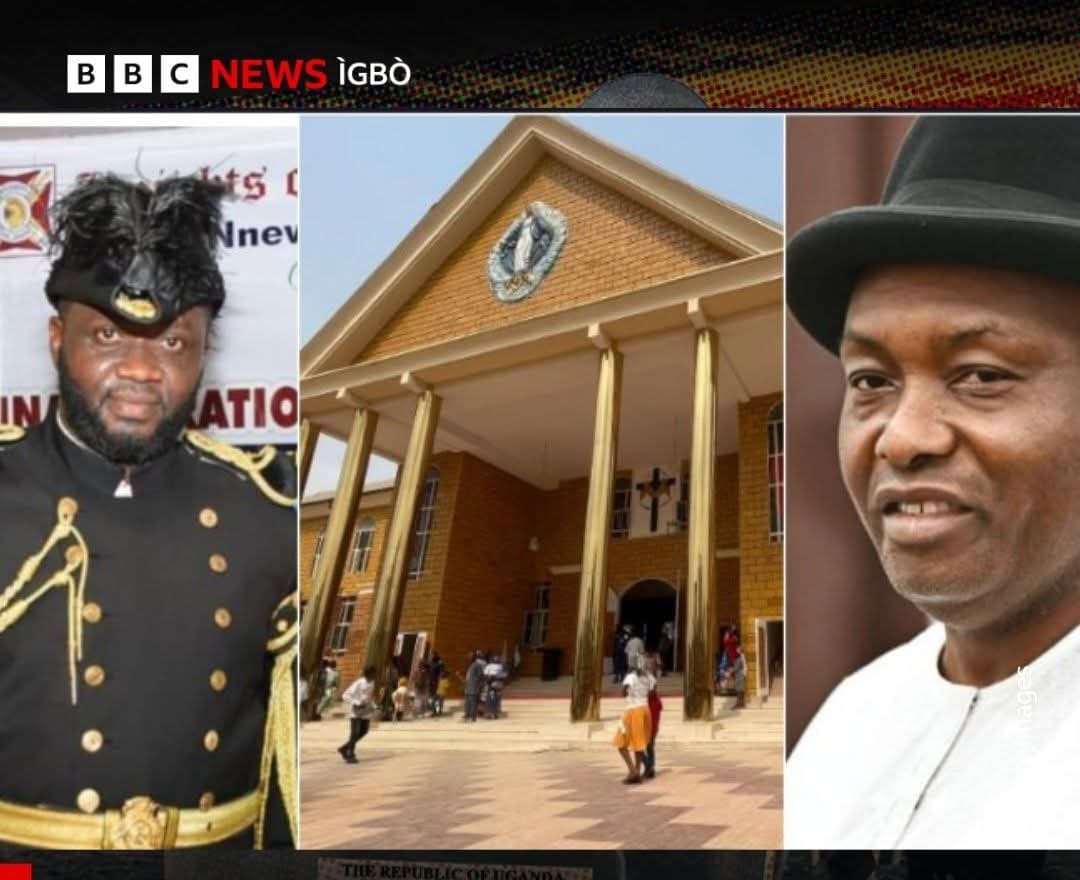
Ifeanyi Ubah, in life, was a moving train who, out of benevolence or for other reasons, touched so many lives for purposes of charity, philanthropy, or public service. He was everywhere and impacted countless lives. Unafraid, he embraced giant personal and public projects, including the Ifeanyi Ubah Stadium, Nnewi and the Nnewi Catholic Cathedral, which was dedicated yesterday, Wednesday, January 14, 2026, exactly one year and six months after his death.
 During the dedication service of the Nnewi Cathedral on Wednesday, a serious protest was made by now a former Knight of the Church, Sir James Okoye, who removed his shoes and renounced Christianity because, according to him, the late Senator Ifeanyi Ubah was not duly recognized or mentioned at the Cathedral dedication mass. His protest has gained national prominence, featuring on multiple national dailies only a few hours later. Mr. Okoye, who lamented Ubah’s exclusion from such an occasion of the dedication of a Cathedral, that he made a substantial contribution, no, sacrifices towards its construction, protested that such painful oversight cannot be allowed to stand. The new Catheral standing today was Senator Ubah’s idea.
Beyond the protest by Mr. James Okoye, what is actually on trial is the legacy of Ifeanyi Ubah. Although Senator Ifeanyi Ubah was casually mentioned in the remarks by Bishop Jonas Benson, the Bishop of Nnewi Diocese, such sporty recognition has been considered far inadequate by many, given Ubah’s enormous contributions to the Church. As the debate and controversy were going on, an old video surfaced of Bishop Hilary Okeke, the former Bishop of Nnewi Diocese, where he described the Late Senator Ifeanyi Ubah as “the great senator Ifeanyi Ubah who is building this Church.” Some have already bought the old video as a part of Wednesday’s event, but it was an old video from the time Ifeanyi Ubah was alive, and he went to the Church with some of his colleagues and was recognized by the former Bishop of Nnewi Diocese at the mass where the new Bishop was received and handed over by the former Bishop.
Yet, recognized or not, the major takeaway from the event is that human beings have developed a frightening forgetful mindset that tends to mock the dead, and this is without prejudice to the volume of their good deeds. The dead are at risk of their legacies being sidelined and altogether erased by the living, who are ironically also working hard to have a legacy to their names when they die. While alive, people build legacies that are likely to be quickly erased by the living who are building legacies and who will die, and whose legacies risk also being erased. The tragedy of this cycle speaks not just to the fleeting nature of man, but to man’s awkward inability to learn the vanity of life through the treatment given to the dead by the living. Maybe people are not honourable as they often pretend. But almost everyone lives for the moment, for their own ego, and for themselves. No one cares about the fact that the same way they have sidestepped someone’s legacy is the same fate awaiting their own legacy sooner or later.
Senator Ubah, though dead and buried, was a selfless man. People were blessed by his life and generosity. The event of Wednesday and Sir James Okoye’s protestations are a reminder that all of us are mere mortals, and what we do about the dead among us, whether we give due acknowledgement or sideline their contributions, is a judgment by ourselves on our humanity. If we are saying that the legacy of the dead should be buried with them, we are saying that humanity does not need to take or keep records. We are saying that to live does not matter.
About Author