
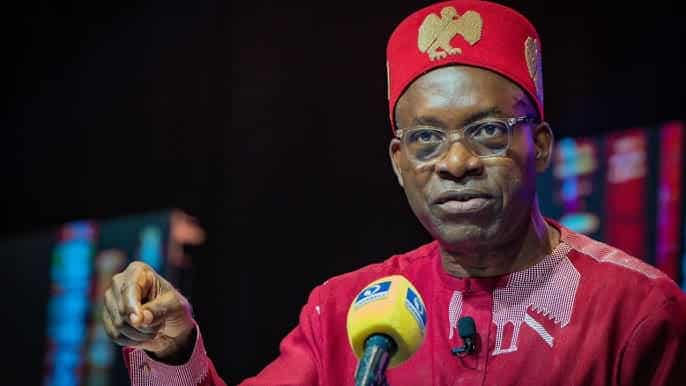
The Special Adviser to the Anambra State Governor on Trade and Markets, Evarist Uba, has said the continued enforcement of the Monday sit-at-home order has cost the state about N8 billion in economic losses every month.
Uba stated that ending the over five-year-old exercise is in the best interest of the state and its residents, noting that the measure has severely affected commercial and economic activities across Anambra.
He made the remarks during an interview at his office at the Jerome Udorji Secretariat Complex in Awka.
 According to him, the state government under Governor Chukwuma Soludo has taken decisive steps to ensure that the sit-at-home practice becomes a thing of the past.
Uba cited the temporary closure of major markets such as Onitsha Main Market and the Nnewi Auto Spare Parts Market as a strong warning to traders who fail to comply with directives aimed at restoring full commercial activities on Mondays.
He noted that the closure and subsequent reopening of the markets sent a clear message that similar sanctions could be imposed on other markets that refuse to operate on Mondays.
The adviser also disclosed that the state government has improved security around markets and constructed access roads to major trading centres to encourage business activities.
According to him, the atmosphere in markets across the state has remained peaceful since the start of Soludo’s administration, which he said is essential for economic growth.
Uba appealed to commercial transport operators to make their vehicles available on Mondays to support the government’s efforts to end the sit-at-home practice.
He expressed confidence that with the measures already in place, the weekly shutdown would soon disappear.
Uba explained that he assumed office following the resignation of the former Commissioner for Commerce, Trade and Industry, Chimaobi Ngonadi, after the ministry was restructured to separate trade and markets from the industry department.
He said one of the policies introduced under his supervision was to ensure that caretaker committee chairmen of markets are traders who own identifiable shops within those markets.
According to him, the policy was designed to ensure that market leaders understand the concerns of traders and are better positioned to implement government directives, including the collection of market revenues.
He added that previous caretaker committee members had treated the positions as political appointments rather than administrative responsibilities.
Uba also highlighted several infrastructure projects undertaken by the state government to improve access to major markets in Onitsha and Nnewi.
He noted that a large refuse dump at Ochanja Roundabout had been cleared and replaced with a water fountain as part of environmental improvements in the area.
He further listed road projects such as the reconstruction of the route from Iweka Road to Moore Street and Main Market, as well as the road connecting Bridgehead to Niger Street and Sokoto Road leading into the market.
In Nnewi, he said the government constructed Bank Road, which runs through the Nnewi Auto Spare Parts Market, and Adili Hotel Road linking to Building Materials Road.
Uba stated that these projects have improved access to the markets and have been welcomed by traders and residents.
He also explained that the ongoing demolition exercise at the Onitsha Main Market is part of the government’s plan to remodel the market in line with the administration’s policy that traders must have proper parking arrangements.
According to him, traffic congestion previously made it difficult for vehicles to access the market, especially on busy market days.
He said the remodelling project will include the creation of parking spaces within the market to ease traffic flow and improve business operations.
Uba added that the restructuring would also help address security concerns, including incidents where traders lost goods to individuals posing as wheelbarrow pushers within the market.
About Author