
By Ebuka Onyekwelu, PhD
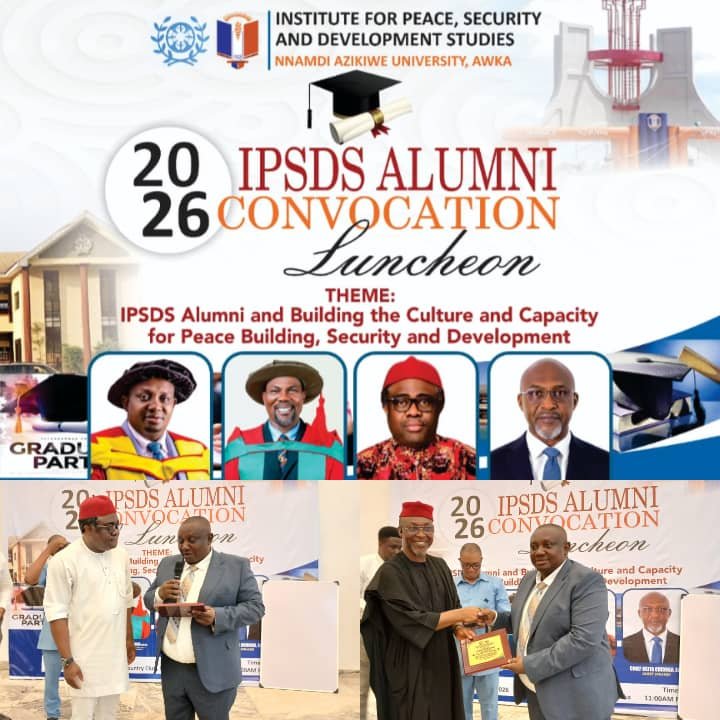
Speakers at the maiden Alumni Convocation luncheon of the Institute for Peace, Security and Development Studies (IPSDS) have called for a union of town and gown to strengthen peace, security, and development at both national and sub-national levels. The luncheon, held on Thursday at the Country Club, Awka, Anambra State, had as guest speakers, former Nigeria’s Minister of Aviation and Chancellor of Athena Centre, Chief Osita Chidoka, Pro-Chancellor of Benue State University and founder of Olivia University, Burundi, Sir Paul Chukwuma, as well as Gen. B. Martins, Deputy Chief of Training, Nigerian Army, who assured of relevant collaboration with the Institute and the peace, security and development community of the Institute. Professor Charles Esimone, former Vice-Chancellor of Nnamdi Azikiwe University, Awka, chaired the event, which was attended by the Vice-Chancellor of Nnamdi Azikiwe University, Professor Ugochukwu Bond Stanley Anyaehie, and his amiable wife, Professor Udo Ego Anyaehie.
The pre-convocation luncheon organized by the IPSDS management, headed by the Institute’s Director, Professor Jaja Nwanegbo, the alumni of the Institute, staff members and other university staff members, was well attended and emerged as a key event ahead of the University’s postgraduate convocation ceremony on Friday.
In his chairman’s opening remarks, Professor Esimone recounted how, as the Vice-Chancellor, he gave his approval for the Institute. “I gave the approval to the idea of the Institute. I can assure us that the IPSDS has the best hands,” Professor Esimone said as congratulate the alumni and called for the integration of academic knowledge and practical experience for the greater good.
Delivering his lecture, Chief Osita Chidoka maintained that such a gathering was uncommon in Nigeria. Drawing insights from Nigeria’s historical experiences, he said that every crisis had an interval when peace builders, security experts and development specialists would have intervened to foreclose the crisis. However, he regretted that this is never the case. Deepening his argument, Chief Chidoka narrated how boycotting call to form national government by the Eastern Region in 1964 created tension. “Two-thirds of the country formed a government…when the government was formed without the Eastern Region, the seed of 1966 was sown,” Chidoka said, pointing out how the 1964 boycott laid the foundation for the civil war a few years later. With this, he submitted that crisis is a product of “accumulation of events.” He also, in retrospect, observed that the Nigerian civil war “could have been averted.” Consequently, he called on peace, security and development experts to pay closer attention to the interval between triggers and the main crisis, so as to identify an intervention window for crisis prevention. Further driving his point home, Chief Chidoka said that when people say “nothing will happen”, he responds that “No, it doesn’t happen overnight,” as he urged peacebuilders to sharpen early intervention for crisis prevention.
On his part, Sir Paul Chukwuma interrogated the theme: “IPSDS Alumni and building the culture and capacity for peace building, security and development”, “to what end?” Chief Chukwuma queried. “The modern issues at stake within the economy of knowledge must be put to the test,” Chukwuma argued, insisting that the time for verbosity and theory is over. “Let’s move away from a war economy to a knowledge economy. Let’s move away from paper to skill set, so that we can match what we do with the realities of our country today,” Sir Paul Chukwuma said. He also proposed policy reforms to strengthen collaboration between academic activities to ensure that they are tailored towards addressing real societal challenges. To this end, he called on the Vice-Chancellor, Professor Anyaehie, to look into ways the IPSDS can be supported to properly position and address societal problems on peace, security and development head-on.
In his submissions, the Vice-Chancellor of Nnamdi Azikiwe University, Awka, Professor Ugochukwu Bond Stanley Anyaehie, thanked the Institute and alumni for such a well-thought-out programme. He also called for collaboration to strengthen peacebuilding, securitization, and development. “We must collaborate to solve society’s problems,” the Vice-Chancellor said.
Guest Speakers and other special guests were presented with a plaque of honour by the Institute in appreciation of their collaboration towards a peaceful, secure, and developed Nigeria.
About Author