
By Uzu Okagbue
There is a dangerous misconception in Nigerian politics that bringing two powerful politicians together automatically creates a formidable governing alliance. It does not. Sometimes, it merely brings two separate ambitions under one campaign banner, postponing their inevitable confrontation until the prize has been won or lost.
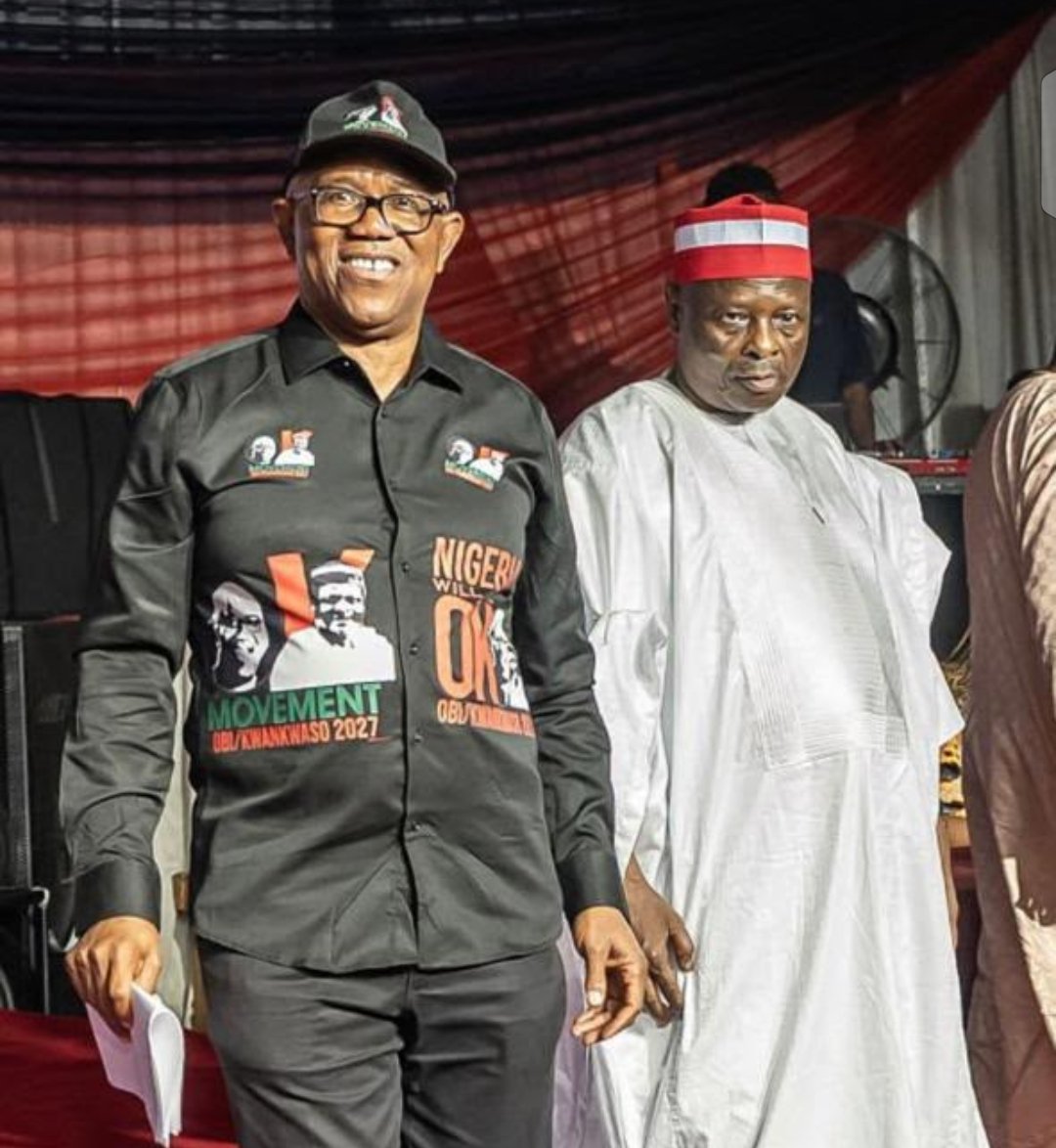
The Nigeria Democratic Congress (NDC), with Peter Obi as its presidential candidate and Rabiu Musa Kwankwaso as his running mate, presents one of the most intriguing political experiments in Nigeria’s contemporary democratic journey.
At first glance, the arrangement looks brilliant. It combines the political energy of the Obidient movement with the entrenched northern political machinery associated with Kwankwaso. It brings together two former presidential contenders whose supporters believe they possess the capacity to fundamentally alter Nigeria’s political direction.
But beneath the electoral arithmetic lies a far more consequential question:
Are these two men united by a common vision of Nigeria, or merely by a common desire to defeat the incumbent?
That distinction could determine not only the fate of the NDC but also the stability of Nigeria’s political future.
The contradiction beneath the ticket
Obi and Kwankwaso did not arrive at the NDC from the same political tradition.
They emerged from different political platforms, different constituencies and different calculations about the Nigerian state. Their political histories have shaped different expectations among their supporters.
The controversy surrounding fuel subsidy is particularly instructive. Obi has argued for the removal of subsidy, while Kwankwaso has spoken of introducing subsidy in a different form. The party has attempted to explain these positions as differences in approach rather than fundamental disagreement.
But Nigerians are entitled to ask: when two leaders offer different interpretations of a major economic policy, which interpretation becomes government policy?
A presidential ticket cannot run a country on political explanations after every disagreement.
The question is not whether two leaders can disagree. Healthy disagreement is essential in democracy. The question is whether their disagreements are governed by a clearly defined policy framework or by the fragile balance of personal political interests.
A joint ticket is not a joint ideology.
The “rig and die” controversy: A campaign slogan becomes a test of leadership
The recent controversy surrounding the “rig and die” slogan has exposed another troubling dimension of the NDC alliance.
The phrase, associated with Ovie Omo-Agege’s warning against electoral manipulation, generated widespread concern because of its apparent threat of lethal consequences against anyone caught rigging the election.
Obi’s subsequent clarification was that the message was directed against rigging, not against campaigning. His distinction was that the movement was saying “rig and die,” not “campaign and die.”
That explanation may clarify the intended political message, but it does not completely resolve the leadership question.
A presidential candidate must understand that language deployed in a politically charged environment can become more than rhetoric. It can shape the conduct of supporters, influence the atmosphere of campaigns and create dangerous expectations about how electoral disputes should be resolved.
The right to defend one’s vote is fundamental. But the defence of democracy cannot become a licence for threats of violence. The ballot must be defended by law, not by the language of death.
The Kwankwasiyya question: Who owns the conduct of the alliance?
The controversy became even more revealing when Obi addressed the presence of sticks and cutlasses at political gatherings.
He identified the Kwankwasiyya movement as a group traditionally seen carrying such items, while insisting that he had not witnessed its members use them to harm anyone.
This is where the political optics become particularly delicate.
Kwankwaso is not an outsider to the NDC. He is the running mate. The Kwankwasiyya movement is not an incidental crowd that wandered into the campaign. It is a significant political constituency within the alliance.
When a presidential candidate publicly identifies one component of his own coalition as responsible for the visible presence of weapons at campaign gatherings, he inevitably raises questions about the relationship between collective political responsibility and individual political ownership.
Is the NDC prepared to take responsibility for the conduct of every group mobilised under its banner?
Or will controversial conduct be explained as the tradition, culture or responsibility of a particular movement within the alliance?
The issue is not whether Kwankwasiyya supporters have a history of carrying sticks. The issue is whether any political movement should normalise the display of potentially offensive weapons at campaign gatherings.
A political leader cannot simply say that he has not witnessed anyone being harmed and conclude that the matter is settled.
The absence of an incident witnessed by a candidate is not the same as the absence of danger.
And the fact that a practice is longstanding does not automatically make it acceptable.
A presidential candidate cannot own the votes of a movement while disclaiming responsibility for the conduct of that movement.
This is precisely the kind of contradiction that could become politically explosive after the election.
Kwankwaso’s supporters may reasonably ask whether their movement is being treated as a valued partner or as a convenient explanation whenever the campaign faces uncomfortable questions.
Obi’s supporters, on the other hand, may insist that the presidential candidate must not be held hostage by the political culture of any component of the alliance.
The tension between those two positions is not difficult to imagine.
The one-term understanding: Agreement or future political fault line?
The reported understanding that Obi would serve one term, after which power would return to the North, introduces another dimension to this alliance.
Kwankwaso has publicly spoken about such an arrangement. If it forms part of the political understanding between the two camps, Nigerians deserve to know its precise terms and the constitutional implications.
A presidency is not a private transaction between political leaders. It is a public trust exercised under the Constitution.
The danger is that an agreement designed to secure electoral cooperation today may become the source of tomorrow’s political conflict.
What happens if the country’s circumstances demand a different political arrangement? What happens if the two camps disagree on the timing, interpretation or implementation of their understanding?
And what happens if the ambitions of other political actors within the alliance begin to compete with the succession arrangement?
These are not idle questions. They are the questions that distinguish political excitement from serious political analysis.
The party, the movements and the struggle for control
The NDC’s internal architecture presents another challenge.
The party has its established leadership. Obi has his political movement. Kwankwaso has his own formidable political structure.
These are not insignificant distinctions.
A political party is supposed to provide the institutional framework through which candidates, supporters and elected officials operate. But when powerful political movements enter a party with their own structures, loyalties and expectations, the party can become a meeting point of competing authorities.
Who controls the campaign machinery?
Who determines the distribution of political responsibilities?
Who controls the relationship between the party leadership and the elected government?
Who decides which interests are accommodated and which are disappointed?
The campaign council and the organisational disagreements surrounding it have already exposed the sensitivity of these questions.
The real danger is not simply that the NDC may experience disagreements. Every political party does.
The danger is that the NDC may discover, too late, that it has assembled powerful political interests without building a sufficiently strong institution to manage them.
The presidency cannot become a referee between competing political empires.
The bigger drama after January 16
The most revealing phase of this alliance may not be the campaign before January 16, 2027. It may be what happens after the election.
If the NDC wins, the alliance will move from the convenience of campaigning to the complexity of governing.
The presidential candidate will be expected to exercise presidential authority. The running mate will bring his own political constituency, expectations and influence. The party leadership will expect recognition for its role in creating the platform. The movements that mobilised voters will expect access, influence and a meaningful place in the new political order.
That is when the contradictions may become impossible to conceal.
The first major test will be appointments. The second will be economic policy. The third will be control of the party and government structures. The fourth, perhaps the most sensitive, will be succession.
The recent “rig and die” and weapons controversy offers a preview of the kind of disagreement that could emerge: one camp may insist on collective responsibility, while another may argue that its own movement should not be blamed for the conduct of a different political constituency.
The same question will arise over appointments, policy failures and the distribution of political power.
Who will take responsibility when the alliance encounters its first serious crisis?
Who will be blamed when expectations are not met?
And who will have the final authority to settle the dispute?
The same political arrangement that appears attractive during an election could become a source of tension when decisions must be made and interests must be sacrificed.
There is also the possibility that the alliance may face a different kind of crisis if it loses. In that circumstance, the question of who contributed more, who compromised more and who should lead the next political direction could reopen old wounds.
Either way, January 16 may not end the NDC’s political drama. It may simply change its location.
The unholy alliance question
Many Nigerians who welcomed the Obi-Kwankwaso arrangement saw it as a necessary political marriage: a combination capable of overcoming regional fragmentation and challenging the established political order.
That aspiration is understandable.
But an alliance becomes dangerous when its supporters mistake electoral convenience for political compatibility.
The phrase “unholy alliance” should not be used as a substitute for evidence. The more serious indictment is that an alliance can become politically unhealthy when its leaders fail to explain the compromises that bind them, the obligations they have undertaken and the limits of their cooperation.
The NDC must answer a fundamental question: is it building a new political institution for Nigeria, or merely providing a temporary shelter for competing presidential and succession ambitions?
The distinction matters enormously.
Nigeria has suffered from political arrangements in which the public is invited to celebrate unity before being told the price of that unity.
Nigeria deserves more than political arithmetic
The Nigerian electorate is not merely a collection of regional voting blocs to be assembled through negotiations among political elites.
It is a population demanding security, jobs, affordable living, credible institutions, education, healthcare and responsible leadership.
A political alliance must therefore be judged by more than the number of votes it can theoretically7 combine.
It must be judged by the coherence of its programme, the integrity of its leadership, the clarity of its commitments and its capacity to govern without being consumed by internal competition.
The NDC may yet demonstrate that its alliance is stronger than its contradictions. It may harmonise its policy differences, clarify its succession arrangements and build an institution capable of managing competing political interests.
But until that happens, Nigerians are right to remain watchful.
The coming election is not simply a contest between political parties. It is a test of whether Nigeria’s political class has learnt that the road to power and the responsibility of governing are two entirely different journeys.
The most consequential question about the NDC is not whether Obi and Kwankwaso can win together. It is whether they can govern together when the interests that brought them together begin to pull them apart.
And the latest controversy has sharpened that question: can a presidential candidate speak for the entire alliance when it is time to claim political credit, yet identify a particular movement within that alliance when the conduct of campaign supporters becomes controversial?
That is not a minor campaign disagreement. It is a test of political ownership, leadership discipline and the meaning of partnership.
That is the political drama Nigerians must watch.
And if the alliance fails to resolve its contradictions before power is won or lost, the real story of the NDC may begin not on January 16, 2027, but on the morning after.
About Author