
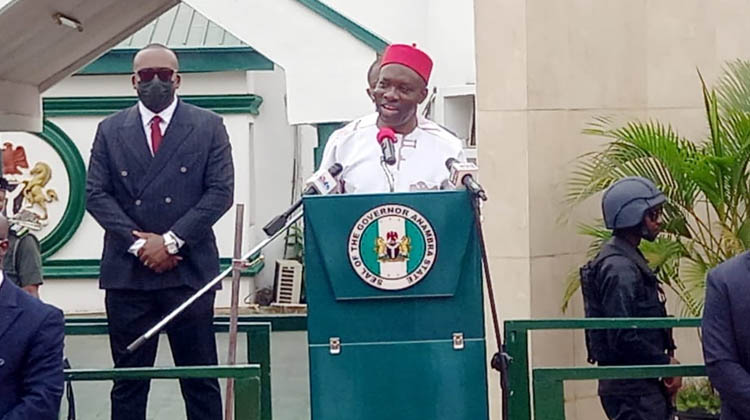
Four years ago, Ndi Anambra trusted Professor Charles Chukwuma Soludo to transform their state into a model of progress, the “Dubai of Nigeria.” Today, that dream lies in ruins. Like the tragic Icarus of Greek myth, Soludo’s soaring ambition melted in the heat of hubris, leaving behind a trail of broken promises, fear, and disillusionment.
In the timeless pages of Greek mythology, Icarus is remembered not for his flight, but for his fall. Gifted with wings crafted from wax and feathers, he was warned by his father, Daedalus, not to soar too close to the sun. But intoxicated by the thrill of ascent, Icarus ignored wisdom. The wax melted, the wings gave way, and the boy who once kissed the clouds plummeted into the sea.
Today, in the political theatre of Anambra State, Governor Charles Chukwuma Soludo stands as a modern Icarus, a man whose early flight stirred hope and admiration, but whose pride and inconsistency have brought his government dangerously close to political self-immolation.
 During his campaign for office, Soludo made promises of a Philosopher-King, and Ndi Anambra fell for them, casting their ballots with uncommon optimism. They elected not just a politician but a professor, a globally celebrated economist once courted by presidents and financial institutions. Soludo promised to turn Anambra into an Eldorado, making her cities hum with enterprise, illuminating her streets, and inspiring her traders.
He styled himself Charly Nwamgbafor, the son of simplicity, a philosopher-king who would govern with moral restraint and intellectual clarity. He paraded himself in akwa ocha akwete, locally made shoes, and only to consume local foodstuffs and drinks. He championed prudence and spoke like one who understood the burdens of the downtrodden. It was to be a government of ideas, frugality, vision, and transformation. But alas, like Icarus, Soludo’s wings were held together not by conviction but by wax, and the heat of power has since revealed the fragility of his philosophy.
His initial pretentious gospel of frugality and even legislated modesty in burial rites, or a moral sermon on living within one’s means, soon gave way like the duplicitous gods of Olympus; he revealed his true face. The same man who warned against extravagance hosted an ostentatious wedding for his daughter in Abuja, far from the soil he governs, drawing his entire cabinet away from their governance duties. The optics were scandalous: while Anambra burned, her governor danced in the capital’s opulent halls.
He followed this with the construction of what is arguably Nigeria’s most expensive State Government House, a “city within a city”. At the same time, Onitsha’s roads decay, drains clog, and streetlights fade into darkness. To the weary citizens navigating potholes and flooded markets, such profligacy feels like mockery; a king building a palace while his people drown.
As time revealed, his reign was to be one of fear and contradiction. Under him, Anambra has descended into an unprecedented climate of insecurity in its history. The same state that once prided itself as a sanctuary of commerce and industry has become the Southeast’s epicentre of fear. Armed gangs roam unchecked, kidnappings multiply, and traders in Ose, Fegge, and Onitsha count their losses under the shadow of violence.
In a desperate bid to restore order, Soludo unleashed paramilitary forces, Udogachi, Agunechemba, and the dreaded Akaodo, whose poorly trained operatives have become the very terror they were meant to fight. Like Ares, the god of war, they have spilt innocent blood, turning Anambra’s streets into battlegrounds. The state, once famed for enterprise, now quivers under the boot of state-sanctioned fear. Even more troubling is the governor’s penchant for scapegoating, blaming traditional practitioners for insecurity yet leaving the root causes untouched. The result? A state that bleeds from both the wounds of violence and the arrogance of denial.
He vowed to tackle flooding in Ogidi, but when the torrents came, he blamed his predecessors, the eternal excuse of a bad workman. Even the once vibrant streets of Awka have lost their lustre, as the governor’s rhetoric continues to outshine his record.
Soludo now realises, perhaps too late, that he has failed to earn the people’s confidence. And in that realisation, he has reached for the oldest and most dishonourable tool of the desperate, cash-for-votes. His administration’s descent into this sordid practice, allegedly involving the offer of money in exchange for ballot marks, is not just a political misstep but a moral collapse. It transforms democracy into a marketplace where conscience is traded for currency and civic duty auctioned for short-term gain. In this single act, he has betrayed the very soul of leadership, reducing the philosopher-king to a mere trader in mistrust.
Soludo’s story, therefore, mirrors the situation of Icarus, in which leadership becomes hubris: not merely because of his fall from grace, but because his arrogance was foretold. Like the youth who refused to heed Daedalus’ counsel, Soludo ignored the moral boundaries that once defined him. He has been aptly described as a man caught in the storm of inconsistency. He has become a leader who preaches simplicity yet practises extravagance, who advocates integrity yet thrives on contradiction. Leadership, as the ancients taught, is not about proclamations but about pathos, the moral fibre that binds word and deed.
The question before Ndi Anambra is not whether Soludo might still win the November 8 elections, as he might. The real question is whether he deserves to. And the answer, by every moral, economic, and philosophical measure, is a resounding no. Democracy is not about rewarding failure but about holding power accountable. Even if Soludo secures victory, it will not be a triumph of governance but of manipulation and vote-buying. The kind of Pyrrhic victory that leaves a state poorer in spirit and more inadequate in truth.
Unfortunately, Anambra cannot afford another term of drift. The state that produced Nnamdi Azikiwe and Chinua Achebe deserves better, a leader with the humility of Daedalus, not the hubris of Icarus. Soludo has had his chance, and he has squandered it.
About Author