
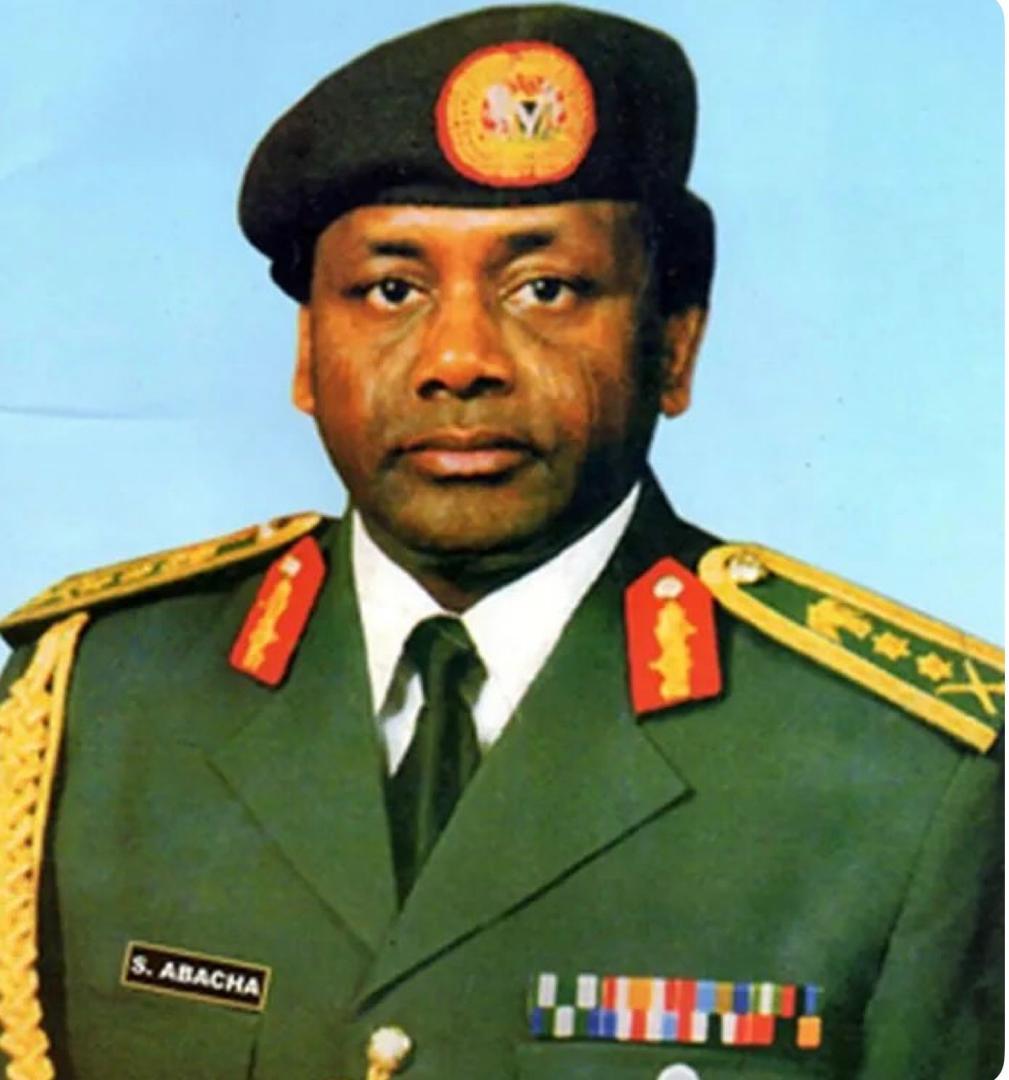
Nigeria did not merely judge General Sani Abacha; it outsourced its conscience to him.
Over time, the phrase “Abacha loot” ceased to be an allegation anchored in forensic detail and became a political slogan: useful, repeatable, and intellectually unchallenged. Yet slogans do not explain history; they simplify it to hide uncomfortable truths. And the truth Nigeria has refused to confront is that Abacha’s demonization has functioned less as justice and more as a moral diversion from deeper, ongoing corruption embedded in the civilian order that followed him.
Let us first deal with facts that are deliberately ignored.
 Under Abacha, Nigeria achieved one of the most disciplined macro-economic positions in its post-civil war history. External debt was substantially reduced, foreign reserves rose from near-collapse to over $9 billion, inflation was tamed relative to preceding years, and Nigeria recorded consistent GDP growth despite international sanctions. The country funded itself largely without the reckless borrowing culture that later became normalized under “democratic” governments. These are not opinions; they are records.
Abacha also oversaw the most aggressive expansion of strategic infrastructure funding in decades; defence capability, energy stabilization, road rehabilitation, and petroleum sector consolidation, largely through centralized control that curtailed elite leakages. Ironically, it is this very discipline that made him intolerable to entrenched interests, local and foreign.
Now to the question Nigeria avoids: how exactly did Abacha personally move vast sums to Europe?
This is where the narrative collapses under its own weight.
Abacha was not a globe-trotting leader. He barely travelled outside a few African countries. He did not run a lifestyle presidency, did not vacation in Europe, did not maintain foreign political networks in the manner common today. Yet Nigerians are asked to believe that vast European financial architectures were personally navigated by a man whose operational style was inward, militarily structured, and tightly controlled.
Subsequent “recoveries” raised even more disturbing questions. Funds allegedly traced to Abacha surfaced in jurisdictions long after his death, sometimes through intermediaries who had stronger ties to post-Abacha administrations than to Abacha himself. More revealing still, some recovered funds never returned to Nigeria in full, or returned only to vanish again under civilian custodianship, with no commensurate infrastructural footprint to show for them.
If Abacha was the thief, why did the theft continue after his death?
Why did recovered funds require “monitoring frameworks” with foreign governments if Nigeria’s own institutions were suddenly trustworthy? And why did these recoveries coincide conveniently with international legitimacy campaigns for new civilian regimes?
These are not conspiracy theories; they are questions of political economy.
The uncomfortable reality is that Abacha became a symbolic sacrifice: a necessary villain through whom Nigeria could rebrand itself without reforming itself. By concentrating all moral outrage on one man, the country avoided examining how corruption evolved, becoming more procedural, more legalistic, more devastating, under democratic cover.
This is why no other leader, despite presiding over far larger revenues and deeper national decline, has been similarly branded. Abacha is maligned not because he was uniquely corrupt, but because he was uniquely inconvenient.
History will eventually rebalance this narrative. But before history does, courageous Nigerians must begin the conversation now, calmly, factually, without emotional blackmail. Nations do not mature by repeating comfortable lies; they mature by confronting inconvenient truths.
Those who understand this are not defending Abacha.
They are defending truth, balance, and Nigeria’s right to an honest memory.
And in a political environment addicted to slogans, anyone who insists on thinking is already a threat to the old order; and a player to watch.
About Author