
Governor Chukwuma Soludo of Anambra State has stepped in to ease tensions surrounding the long-running traditional leadership dispute in Awka, suspending plans to prosecute individuals linked to the crisis and opting instead for reconciliation and dialogue.
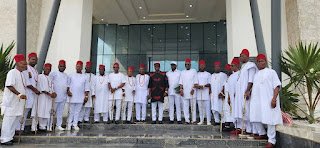
The governor made the disclosure during a high-level engagement with the Ozo Awka Society at the newly completed Light House complex in Awka, where he said his administration would prioritise peace and stability over litigation.
Governor Soludo said that although the state government has sufficient evidence to proceed with legal action, the decision to hold back prosecutions was taken in the interest of communal harmony.
“We have evidence to proceed, but at this stage, peace and reconciliation must take priority over court action,” he said.
 He explained that the government’s intervention in the dispute was a constitutional responsibility aimed at restoring order to the traditional institution in Awka.
According to him, findings from a Commission of Enquiry recognised Obi Gibson Nwosu as the only legally acknowledged traditional ruler of Awka, in line with existing state laws governing traditional institutions.
He warned that the installation or recognition of parallel traditional rulers is not permitted under Anambra State law and attracts legal consequences.
The governor traced the roots of the crisis to disagreements over burial rites and disputes linked to the community’s zoning arrangement for succession to the throne. He said the established rotational structure reportedly designates Nkwelle village as the next source of a traditional ruler, a process he suggested had been disrupted by internal disagreements and personal interests.
Despite the tensions, Soludo said his administration remained committed to dialogue and internal reconciliation among stakeholders, including aggrieved factions within the community.
The meeting was attended by members of the Ozo Awka Society, government officials and key community leaders.
Responding on behalf of the delegation, Ozo Sir Chukwujekwu Eze welcomed the governor’s conciliatory approach and assured that consultations would be held to resolve the outstanding disputes.
Beyond the traditional leadership crisis, Governor Soludo also used the meeting to restate his administration’s broader urban renewal agenda for Awka, describing it as central to his vision of transforming the state capital into a modern city.
He cited ongoing projects such as the 57-building Light House complex and the Solution Fun City as part of efforts to reposition Awka after years of infrastructural neglect.
The governor urged residents to embrace the city’s transformation and move away from what he described as a “rural mindset,” insisting that Awka was evolving into a 21st-century capital capable of competing with other major urban centres in Nigeria.
He also proposed the construction of a central palace for the Eze Uzu of Awka, describing it as a symbolic cultural project intended to elevate the status of the traditional institution. He pledged state government support to deliver the project within 12 months in collaboration with the community.
On cultural activities, Soludo appealed for a review of the scheduled date for the Imo Awka Festival, citing concerns that a major statewide event planned for May 23 could overstretch security and logistics arrangements.
The meeting was attended by senior government officials, including the Secretary to the State Government, Mrs. Chiamaka Nnake; the Chief of Staff, Chief Ben Nwankwo; and the Attorney General and Commissioner for Justice, Barr. Tobechukwu Nweke.
Also present were prominent Awka stakeholders, including Chief Fred Chinwuba, Prince Chinedu Okafor, the President General of Awka Development Union Nigeria, and the Prime Minister of Awka, Chief Benjamin Okoye.
The discussions are expected to continue as the state government pushes for a peaceful resolution to the crisis while advancing its wider urban development agenda for the capital city.
About Author