
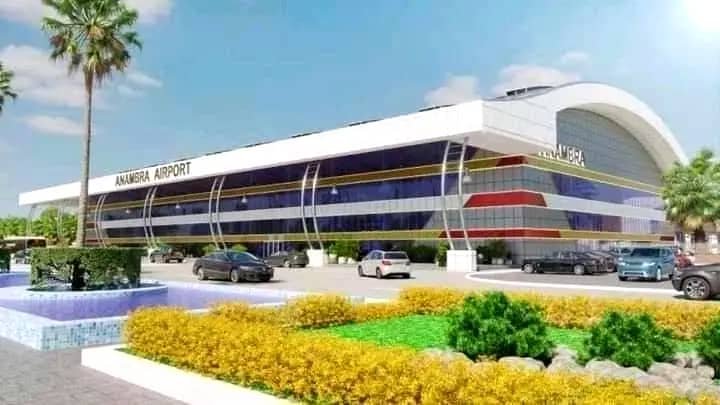
The Anambra State Government has disclosed plans to develop a third airport with efforts already underway to secure land for the proposed facility as part of its long-term development vision.
The Commissioner for Works and Infrastructure, Arc. Okey Ezeobi, disclosed this at the 2026 conference of the Nigerian Institute of Architects, Anambra State Chapter, explaining that the plan was designed to accommodate future population growth, economic expansion and increasing demand for air transportation.
Ezeobi said construction of the state’s second airport was ongoing, while the government was making provisions for a third airport under its Vision 2070 development plan.
He explained that the decision was informed by the need to anticipate future infrastructure requirements rather than wait until population growth and increased economic activities put pressure on existing facilities.
According to him, failure to plan ahead could leave the state struggling with inadequate aviation infrastructure, including limited capacity to accommodate additional flights as demand for air travel increases.
The disclosure comes amid questions from residents about the necessity of a second airport and whether the state requires additional aviation facilities, given the financial and infrastructural demands involved.
However, the commissioner maintained that the government’s approach was informed by a long-term vision of Anambra’s development, arguing that major infrastructure projects required adequate planning to meet the needs of future generations.
He indicated that securing land for the proposed third airport was part of preparations to ensure that future development would not be constrained by land availability or insufficient infrastructure.
The plan places aviation development within the state’s broader ambition to accommodate expanding economic activities and growing transportation needs over the coming decades.
However, questions remain about the projected demand for air travel, the cost of developing and maintaining multiple airports, and the economic benefits the facilities are expected to deliver to residents.
With 2070 still decades away, the proposed third airport represents a long-term infrastructure ambition whose justification will ultimately depend on population projections, economic growth and demonstrable demand for air transportation.
About Author