
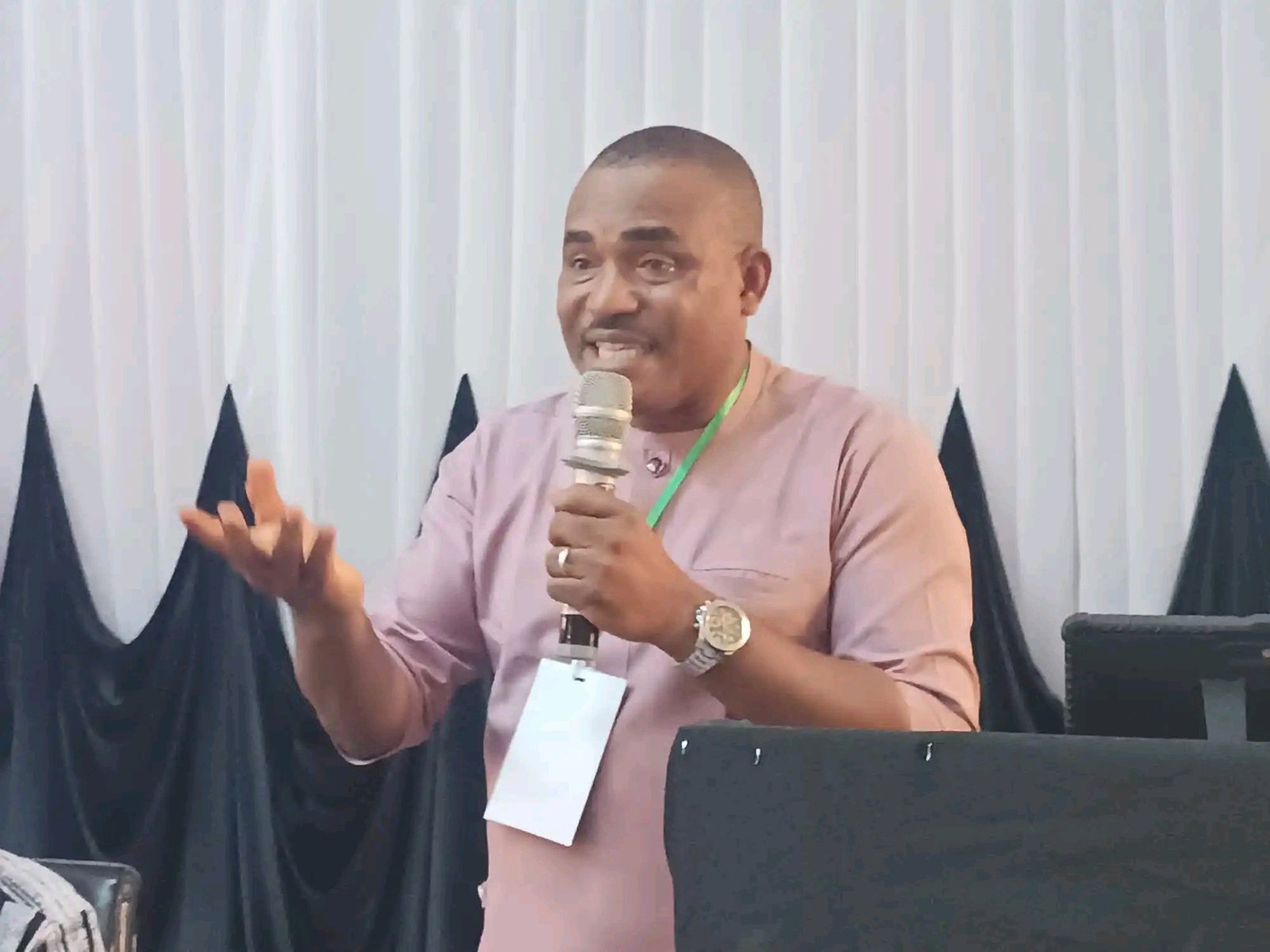
The Anambra State Commissioner for Works, Arc Okey Ezeobi, has disclosed that an estimated 5,075 buildings will be demolished along the 2nd Niger Bridge corridor to give way for a six-lane road along Nkwele-Ezunaka, Oyi Local Government Area.
The commissioner stated this at the 2026 Annual General Meeting (AGM) of the Anambra State chapter of the Nigerian Institute of Architects (NIA), held at the weekend in Awka, the state capital.
Arc Ezeobi, in his keynote speech titled “From Vision to Legacy: Planning, Innovation and Inclusive Development for a Livable Environment,” said that, for the environment to be successful and liveable, there has to be some planning, and that when members of the society do not plan, the environment suffers, and the individual members of the society suffer along with it.
He lamented that “if there were a proper master plan, the people would not have to be paying such big price; but today, our people are paying the price because, there was no planning.”
The commissioner said that, “It is planning that has made the second Anambra airport imperative. You plan for the future; you don’t micro manage planning.
“By 2070, Anambra shall have gotten three airports. We are building second airport, and we are securing land for third airport as a vision of where Anambra will be by 2070. This is how we, as a state, are planning for the future, because, if we didn’t plan for the future, we found out that a time would come in Anambra where there would be no space for development.”
He told members of the Nigerian Institute of Architects that planning is something they must not joke with, and that they have to plan and be innovative about how things need to be done.
“As population size is increasing, we have to be innovative about how we are going to handle the increasing population. Erosion has taken away 30% of Anambra land, and if architects failed to sit down and think, things would get out of hand,” he stated.
Also, the Commissioner for Housing and Urban Development, Anambra State, Arc Chiedozie Henry Arize, in his own speech titled “From Brief to Legacy: What Three Decades of Public-Sector Architectural Practice Taught Me,” suggested that a professional architect should develop relevant skills, including visibility, relationship-building, establishing active networks, building digital portfolios and, above all, possessing business and entrepreneurial skills, insisting that it is not good enough to be called a professional architect when one cannot pay his bills.
He also revealed that the state is aggressively pursuing low-cost social housing for public servants, particularly secondary school teachers and civil servants.
The commissioner said the first phase of the social housing to be built in Ebenebe, near Awka, the state capital, would comprise 1,200 housing units, with the second and third phases following thereafter.
According to him, “Governor Charles Soludo is desirous of developing social housing for civil servants in the state. We’ve thought it through. We’ve done necessary design works, and because Anambra has little landmass, the housing will be done in the form of three upper floors in order to contain reasonable number of houses for the targeted population.
“The meeting to this effect was held on Wednesday, October 7. The Federal Mortgage Bank is funding the project, so, money won’t be any problem; and the governor has made land available.”
He said the houses, when completed, would be subsidised so that public servants could afford them, adding that plans had been concluded to ensure that only public servants, not businessmen, benefited from the social housing scheme.
About Author