

Chinedum Treasure
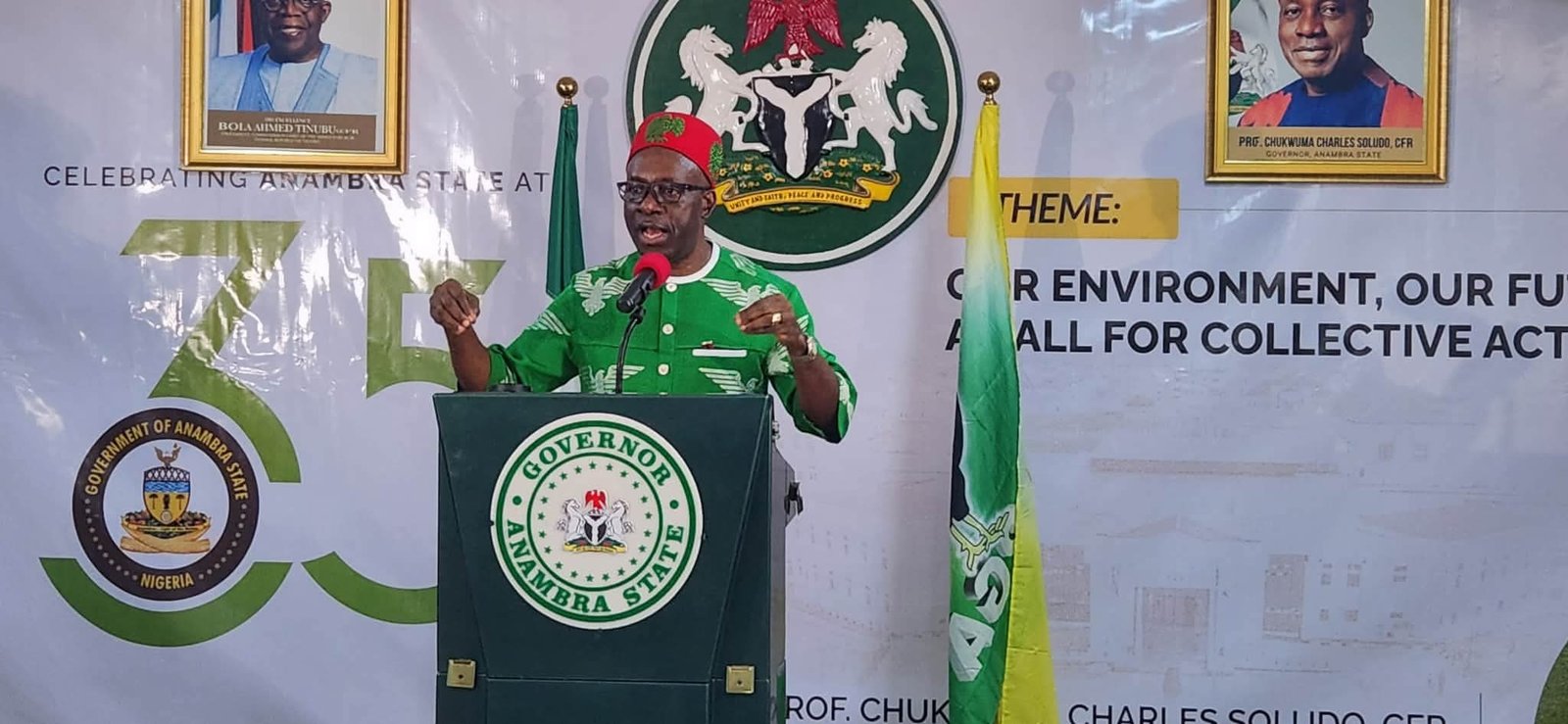
Anambra state governor, Prof Chukwuma Soludo on Thursday declared a state of emergency on the environment in the state, describing environmental degradation as the state’s “number one existential threat”.
He said more than 30 per cent of the state’s total landmass has already been eroded, warning that dedicating the entire state budget to ecological remediation would still fall short of the financial requirement.
Soludo disclosed this during a live broadcast at the Light House, Awka, to mark the 35th anniversary of the creation of Anambra State.
The broadcast, held under the theme, “Our Environment, Our Future, A Call for Personal Responsibility,” also featured the launch of a renewed Clean and Green initiative.
The initiative is aimed at transforming the state into a clean, planned and sustainable habitat.
According to the governor, while significant progress had been made in addressing insecurity since his administration assumed office, the environmental crisis required urgent and collective action.
“Although cities globally are grappling with climate change and flooding, the situation in Anambra is a severe existential crisis, with about 98 per cent of the degradation attributed to human activities.
“Anambra is the gully erosion capital of Africa, if not the world. More than 30 per cent of our total landmass has already been eroded.
“Even if we dedicate the entire state budget to ecological remediation, it will still not be enough to address the magnitude of the problem,” he said.
Soludo listed Nanka, Oko, Amaokpala, Ozubulu, Ogidi, Nkpor, parts of Onitsha and Nnewi among communities experiencing severe erosion, resulting in the collapse of homes, roads and farmlands.
He said the state’s porous soil had contributed to the problem, but human activities had drastically accelerated the degradation over the years.
The governor said available data indicated that the crisis was a cumulative 60-year problem.
He said the problem was driven by blocked drains, unauthorised construction on waterways, uncontrolled run-off and reckless excavation of soil without environmental impact assessments.
He also identified farming on vulnerable slopes as contributing 20 per cent to the crisis, deforestation 13 per cent and indiscriminate sand mining nine per cent.
Soludo acknowledged the efforts of previous administrations in tackling the environmental challenges, adding that his administration had introduced structural measures to address the situation.
He said the measures included opening drainage channels, mainstreaming environmental standards and prohibiting roads from being constructed without proper drainage terminations.
He, however, said the scale of the crisis had surpassed the capacity of government alone, stressing the need to collectivise responsibility and mobilise citizens at the grassroots.
The governor said the state was therefore shifting from a reactive, government-dominated approach to a proactive and community-driven response.
He said traditional rulers, town unions, churches, schools and markets would be expected to mobilise residents to take ownership of their environment.
Under the new directives, he said all 179 communities in the state would be required to undertake daily desilting of drainages, while blocking waterways would be treated as an offence with the support of traditional institutions.
Soludo also directed every household to maintain a waste bin, control run-off water within private compounds and desist from building on waterways.
He said physical planning and environmental education would also be integrated into civic education curricula.
“I urged residents to embrace tree planting and other measures that will promote a greener and healthier environment.
“Use the 35th anniversary of the state to reflect on the legacy inherited from previous generations and take collective responsibility for securing a viable, green and sustainable Anambra for future generations,” he said.
About Author