

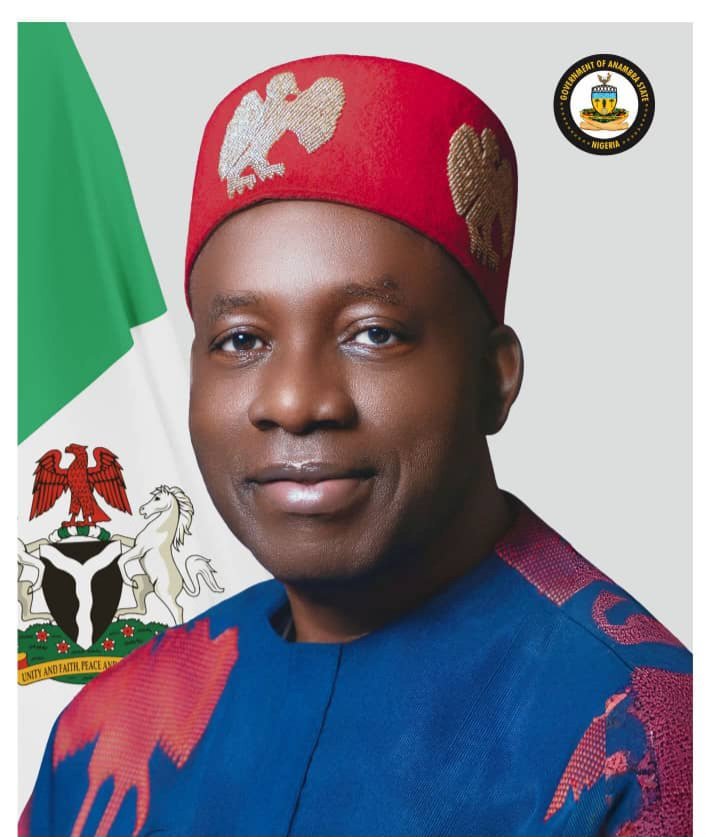
Former President of Transcorp, Chief Obinna Ufudo has criticized Anambra State Governor, Professor Chukwuma Soludo over what he described as unnecessary demolition of popular Afor Nnobi Market Market in Idemili South Local Government Area of Anambra State.
In an article titled; Governor Soludo and Afor Nnobi: When development destroys the people it is supposed to serve he wrote:
There are moments when silence ceases to be restraint and becomes complicity. For me, the destruction of Afor Nnobi Market by the Anambra State Government is one such moment.
I have watched with disbelief as the economic nerve centre of my hometown has been demolished in the name of development, first with the destruction of a significant portion of the market and adjoining properties for road dualisation, and now with the complete destruction of the market for a proposed flyover at Nnobi Junction.
I believe strongly in development and modern infrastructure. Anambra needs better roads, improved traffic management and better-planned towns. I therefore have no objection in principle to road dualisation through Nnobi or even to a flyover if a proper traffic and engineering study establishes that it is the best solution.
But development that destroys the economic lives of thousands without first providing for their survival is not development. It is impoverishment by public policy. Sadly, that is what Governor Soludo has done in Nnobi.
Afor is not just another market
Afor Nnobi is not simply a collection of stalls standing inconveniently in the path of a government project. It is an ancient institution, well over a century old, and for generations has been the commercial heart of our town. Farmers, traders, artisans, transporters and surrounding property owners all depend on the economic ecosystem it sustains. Generations of families have built their livelihoods around it.
Nnobi is itself an important confluence town. Our famous junction connects traffic towards Nnewi, Awka-Etiti, Adazi, Agulu, Umuoji, Nkpor and other surrounding communities. Afor grew at this intersection because people, goods and commerce naturally converged there. The congestion at Nnobi Junction is therefore not merely evidence of a traffic problem. It is also evidence of the commercial importance of the location.
Only a few months ago, roughly a quarter of the market and adjoining properties were destroyed for road dualisation. Traders lost businesses built over decades and families lost inherited properties. Our people had barely absorbed that shock when Government returned to take the rest. Today, thousands who previously knew where they would earn their living no longer have businesses to go to. Some families have lost ancestral homes and are taking refuge wherever shelter can be found. Even ancestral burial grounds have reportedly been swept away with astonishing insensitivity.
Development must have a human face
What kind of development begins by destroying the livelihood of the very people it is supposedly intended to help? Why was a replacement market not built first? Why were traders not properly enumerated, relocated and allocated alternative spaces? Why were property owners not valued and compensated before demolition? Where are the environmental, social and economic impact assessments and the resettlement plan? What alternatives were considered before eliminating the economic centre of an entire community?
These questions are particularly pertinent because our Governor is Professor Charles Chukwuma Soludo, an economist of international standing and former Governor of the Central Bank of Nigeria. He should understand better than most that infrastructure projects have benefits and costs.
Responsible public policy identifies those costs, determines who bears them and makes provision to mitigate them. Where people must be displaced, they should be compensated and resettled before their economic lives are destroyed. That is not charity. It is elementary development economics.
You cannot bulldoze a man’s shop on Monday and promise him development on Friday when his children must eat on Tuesday. Neither can you destroy the stall of a poor widow whose entire working capital may be a few hundred thousand naira and tell her she is making a necessary sacrifice for Anambra’s future prosperity. Her livelihood is not an inconvenience standing in the path of development. Her livelihood is the very purpose of development.
Why must it be a flyover?
Does Nnobi Junction actually require a flyover? Were less expensive and less disruptive alternatives properly examined? Much of the traffic arriving at the junction is simply passing through. Could some of it not be diverted through existing roads with modest improvements and proper signage? What about better junction design, properly located motor parks, disciplined loading points and enforcement against roadside parking?
There is an increasingly disturbing penchant in Nigerian governance for large and visible “signature projects” when simpler interventions may solve the problem. Flyovers photograph well and provide wonderful backdrops for commissioning ceremonies.
But infrastructure planning cannot become an architectural competition between governments. The proper question is what solution delivers the greatest benefit at the lowest financial, social and economic cost. If a ₦1 solution adequately solves a ₦1 problem, spending ₦10 while destroying another ₦20 of existing economic value is simply bad economics. If any governor should understand that, surely it is our professor of economics.
The Ekwulobia Warning
And then there is Ekwulobia. The flyover there was constructed by the Soludo administration in 2024, yet more than two years after its completion date, the Government was still talking about formally commissioning it amid concerns and allegations about cracks and structural defects.
Government insists that engineering integrity tests found the structure safe, but its prolonged non-use raises legitimate questions about the quality and execution of this Government’s infrastructure projects.
For Nnobi, the question is obvious. If Ekwulobia flyover built at enormous financial and social cost, can remain effectively unused for so long while controversy persists over its structural condition, what exactly is the great hurry to destroy Afor Nnobi for another one? Why could Government not first build an alternative market, relocate traders, compensate affected property owners and resettle displaced families?
Ekwulobia should have taught Government the proper sequence. Build the alternative. Relocate the people. Compensate those affected. Then demolish what is absolutely necessary.
Bulldozing first and attempting to manage the human misery afterwards is not orderly development.
People, not structures
Government will usually speak of “structures affected”, “right of way recovered” and “road corridor cleared”. But behind every one of those structures may be the school fees of children, the medical bills of elderly parents or the accumulated savings of several generations.
A trader who has spent twenty years building a business around one location has built more than a physical shop. Customers, suppliers, credit relationships and transport patterns form an economic ecosystem. Destroy that ecosystem and you may have destroyed the business even if you later give the trader another stall.
The destruction of ancestral compounds is even more troubling. In Igbo society, land is not merely an asset measured in square metres. It carries history, identity, lineage and memory. Government may possess legal powers to acquire land for public purposes, but that power must be exercised with fairness, restraint and compassion.
There is also a wider problem with governance in Nigeria. People elected to serve increasingly behave as though they were elected to rule. Government announces and citizens are expected to obey. Government marks your building and you panic. Government arrives with bulldozers and your family is scattered. Compensation, if it comes at all, becomes something the victim must endlessly pursue. Anyone questioning the wisdom or humanity of the decision is portrayed as an enemy of development.
Ndi Nnobi are not obstacles to the development of Anambra State. We are citizens of Anambra State. The traders of Afor are not statistics. They are the people for whom government exists.
Much of the destruction cannot now be reversed, but its human consequences can still be mitigated. Governor Soludo should urgently order a transparent enumeration of displaced traders, tenants, landlords and households, pay adequate compensation, assist families rendered homeless and provide temporary trading facilities while a replacement market is developed. Displaced Afor traders must receive priority in the allocation of shops.
Government should also publish the environmental, economic, social and traffic assessments underpinning the project and subject the proposed flyover to an independent and public review. If the flyover remains the best solution, so be it. If diversions, junction redesign and other interventions can achieve substantially the same result at lower cost and with less human misery, the Governor should have the courage to change course.
Most importantly, Professor Soludo should come to Nnobi and listen. Not merely to inspect construction works or explain decisions already taken, but to sit with the traders, affected families, traditional institutions, town unions, elders, professionals and young people whose lives have been turned upside down.
Do not push the people too far
Nigeria is already going through an extraordinarily difficult period. Food is expensive, insecurity abounds, businesses are struggling and youth unemployment remains a serious social danger. This is precisely the wrong time for public policy to manufacture additional economic casualties.
A young man who had a shop last week and has nothing today has lost more than a structure. He has lost his income, his independence and perhaps the capital he spent years accumulating. Multiply that across hundreds or thousands of people and Government may have created a social problem far more dangerous than the traffic problem it set out to solve.
Our leaders should not mistake the patience of ordinary people for permanent acquiescence. There is a limit to how much economic pain people can absorb and how often the poor can be asked to sacrifice everything while those who exercise power sacrifice little. When people are pushed repeatedly until their backs touch the wall, eventually they push back. Government should pay attention to the anger in Nnobi today. It is deep, widespread and real.
Governor Soludo has embarked on an ambitious infrastructure programme across Anambra State, but kilometres of asphalt and numbers of flyovers cannot be the ultimate measures of development. The true measure is whether the lives of the people are better. A beautiful road running through an economically devastated community is not progress. A magnificent flyover standing over the ruins of hundreds of livelihoods is not a monument to development. It is a monument to poor planning. And to insensitivity.
Nnobi wants development. We welcome better roads and want our ancient town transformed into a modern and prosperous community. What we reject is the proposition that our people must first be impoverished in order to be developed. Governor Soludo should return to Nnobi, see the anguish for himself, compensate the dispossessed, relocate the traders, help displaced families rebuild their lives and reconsider the flyover if a simpler solution will work.
There is still an opportunity for Professor Soludo to show that development under his watch has a human face. He should take it. However impressive our roads and bridges may become, you cannot build a liveable homeland by making its people economically homeless. Development must serve the people. The people must never be sacrificed to development.
About Author